The one-stop shop for medical education
SI MedEd is the one-stop shop for medical education: 4,238 original, triple-checked practice questions across Step 1, Step 2 CK, Step 3, and the MCAT — plus a practice builder, flashcards, and Study mode with spaced repetition. Elsie, an AI tutor and copilot, answers from the same shared brain everywhere. Faculty get a full professional toolkit for exams, analytics, and accreditation — and the family includes the most robust LCME accreditation guide anywhere. No login wall to look around; start with a free 7-day trial, no card required.
This site is unofficial: it is not affiliated with, sponsored, or endorsed by the NBME, USMLE, LCME, NRMP, AAMC, or any medical school. The authoritative sources are always the official sites — usmle.org, nbme.org, lcme.org, nrmp.org, and aamc.org.
For students
A 4,238-question bank — Step 1 (1,266), Step 2 CK (718), Step 3 (664), MCAT (1,590) — every question original and triple-checked: written fresh, then solved cold twice by independent reviewers before it ever ships. Build fresh practice sets by exam, discipline, and difficulty; drill flashcards; let Study mode schedule your spaced repetition; ask Elsie, your AI tutor, to talk you through anything you miss; and watch your progress across every exam from one dashboard.
After your free 7-day trial. No card required to start. Cancel anytime.
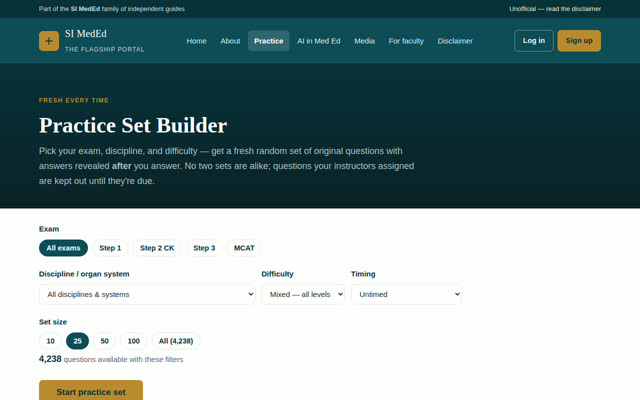
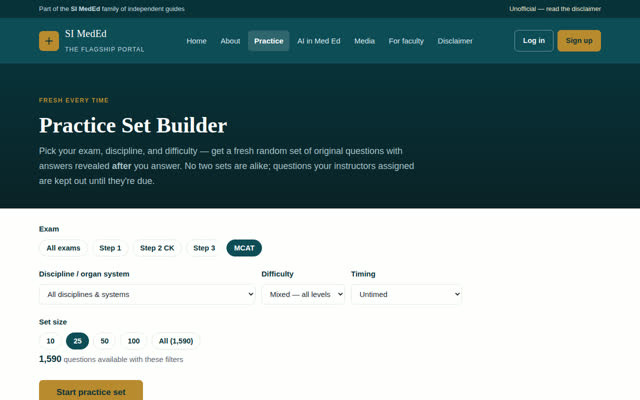
Pick your exam, discipline, and difficulty — get a fresh random set every time. Assigned questions stay out until they’re due.
Open the builder →Decks by exam and topic — quick-fire against the clock, one card at a time, with spaced repetition built in.
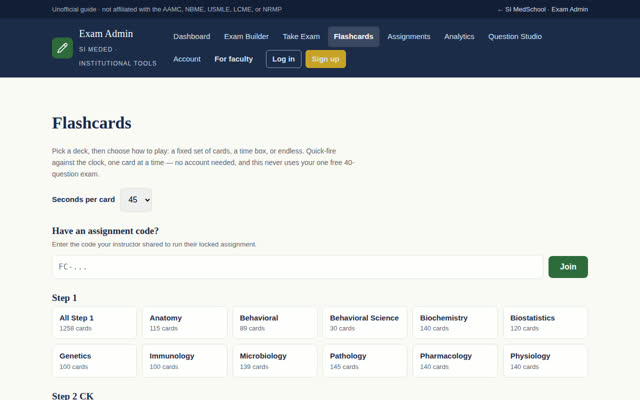
Browse the decks →Spaced repetition, done for you: every card returns at 1, 3, 7, 14, then 30 days — and your weak topics surface on their own.
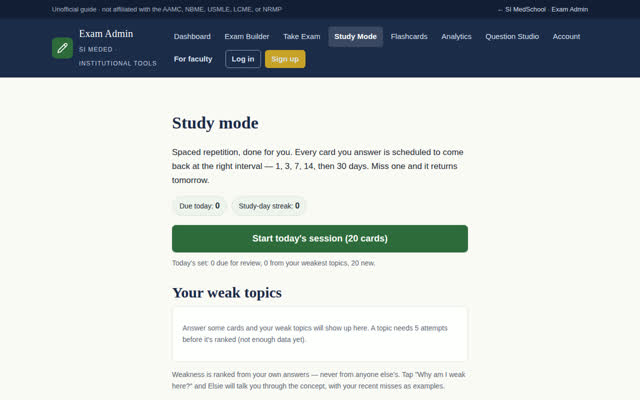
See Study mode →A 73-second captioned walkthrough of the student side — real screens, no staging. Read the captions as text.
For prospective students
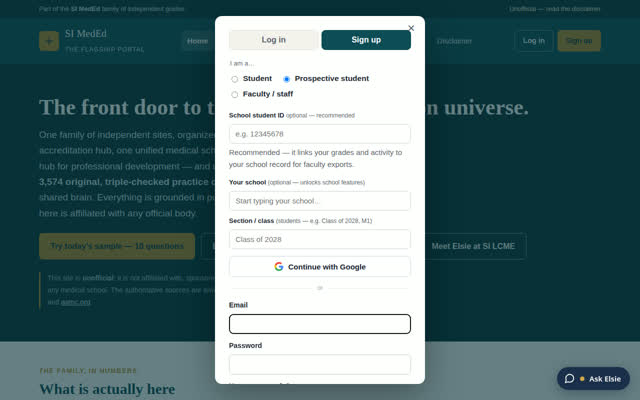
Everything a future applicant needs in one account: a 1,590-question MCAT bank across all four AAMC sections, admissions guides that walk the application section by section, school lists you can browse — and a “schools I’m considering” list that stays with your profile. Sign up with the Prospective student role and the same account grows with you into medical school: MCAT today, Step 1 tomorrow, Step 2 CK after clerkships.
After your free 7-day trial. No card required to start. Cancel anytime.
1,590 original MCAT questions — passage-based where the AAMC is passage-based — with the same triple-check as every bank.
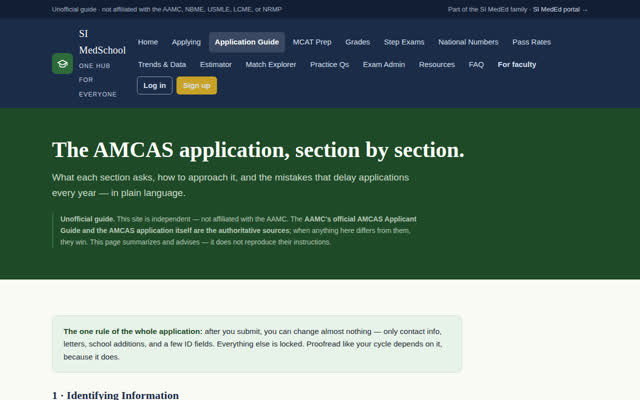
Try the MCAT builder →The application, section by section — what each part asks, what it’s really measuring, and how to approach it.
Read the guides →One tap opens signup with “Prospective student” already chosen — plus your school list and section picker.
Sign up as a prospective student →A 61-second captioned walkthrough for future applicants — real screens, no staging. Read the captions as text.
For faculty
Everything for teaching and assessment lives on the faculty page: build assignments with receipt codes, co-write items in the Question Studio with Elsie (every item triple-checked before it saves), work the accreditation / DCI toolkit with a role-aware Elsie, draft the dean’s letter with the MSPE auto-builder, run the gradebook and curriculum mapping, and read class analytics — difficulty, discrimination, and which wrong answers pull hardest. Kept deliberately separate from student study content.
After your free 7-day trial — full toolkit from day one of the trial. No card required to start.
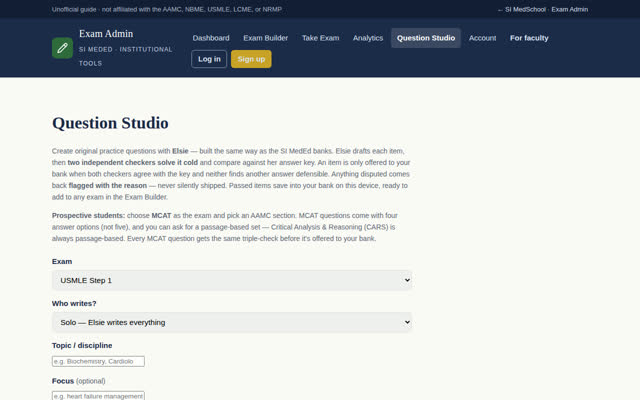
Co-write original items with Elsie — two independent cold solves before anything saves to your bank.
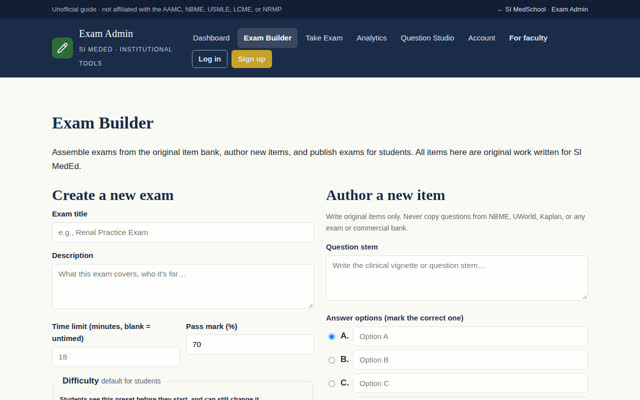
Open Question Studio →Build exams, share them by code, and run real item analysis as results come in.
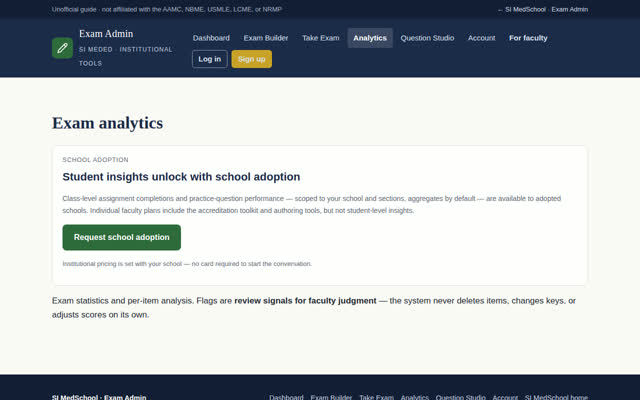
Open Exam Builder →Per-question stats, class performance, and distractor analysis — flags are review signals for faculty judgment.
See analytics →A 73-second captioned walkthrough of the faculty toolkit — real screens, no staging. Read the captions as text.
For schools
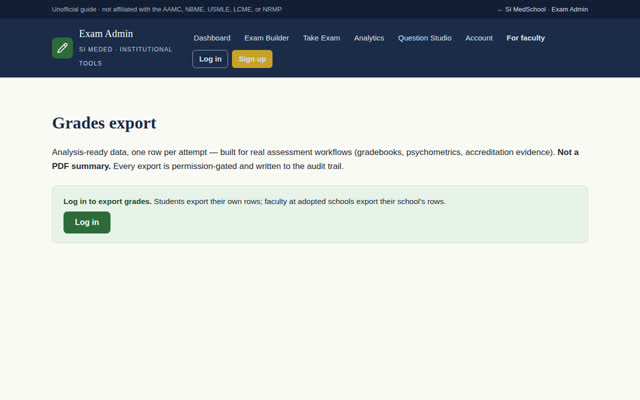
Institutional adoption unlocks the school-wide layer: student-insights dashboards (assignment completions and practice-question performance, scoped to your school and sections — FERPA-aware, aggregates by default), assessment data export (analysis-ready CSV/Excel, one row per attempt, permission-gated and audit-trailed), and accreditation reporting grounded in the standards text. See how adoption works — institutional pricing is set with your school, never a sticker price.
Institutional pricing is set with your school. No card required to start the conversation.
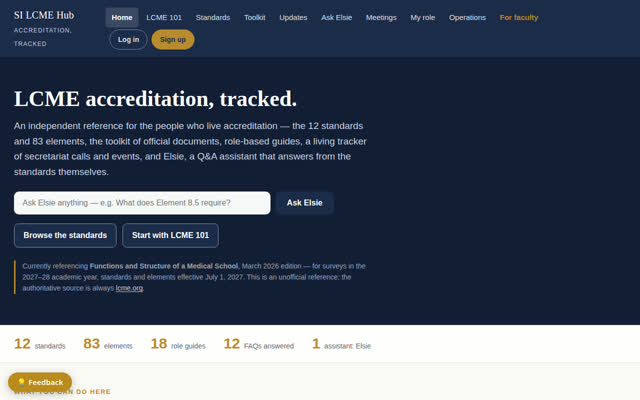
All 12 standards and 83 elements, searchable — plus the accreditation toolkit and Elsie, the accreditation copilot.
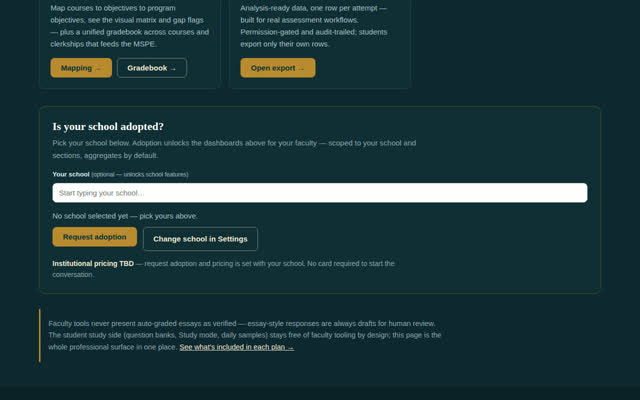
Enter SI LCME →Check whether your school is adopted — adoption unlocks the dashboards for your faculty, scoped to your sections.
Check your school →Analysis-ready data, one row per attempt — built for real assessment workflows, never a PDF summary.
See export →A 61-second captioned walkthrough for institutions — real screens, no staging. Read the captions as text.
Tell us about your institution and we’ll set up a conversation about adoption and pricing — set with your school, never a sticker price.
Price comparison
The big names charge hundreds for a question bank alone. SI MedEd is the full platform — banks, practice builder, flashcards, Study mode, Elsie tutoring, faculty tools, and the accreditation hub — for $7.99 a month after a free 7-day trial. To keep the comparison honest: their prices below are question-bank-only; ours is everything.
Accreditation
The SI LCME hub tracks the standards the way accreditation actually works: every standard and element searchable, an accreditation toolkit of official documents, LCME 101 guides, a monthly updates tracker, role-based briefings — and Elsie, a copilot that drafts, critiques, and reasons from the standards text itself. Built from public, national sources; explicitly unofficial.
How it works
Medical education runs on documents: USMLE content outlines, AAMC admissions statistics, NBME performance profiles, LCME standards, NRMP match data. They are authoritative and, frankly, hard to read — scattered across PDFs, dense tables, and jargon. The SI MedEd family puts the working parts of those documents into plain language in one place, grounded in what the official sources actually say. Nothing here replaces an academic advisor, a licensing bulletin, or the official exam sites. And everything here is explicitly unofficial: these guides interpret public information; they don’t speak for the bodies that publish it.
Every number cited carries a year and a source. No school-internal data, no leaked questions, no confidential anything — only what’s published and citable.
These sites give you the information to think clearly about admissions, exams, and accreditation. They are not a substitute for your own advisor, dean, or the official guidance.
Official publications are summarized and paraphrased, never reproduced at length. The original document is always one click away, with links checked regularly.